




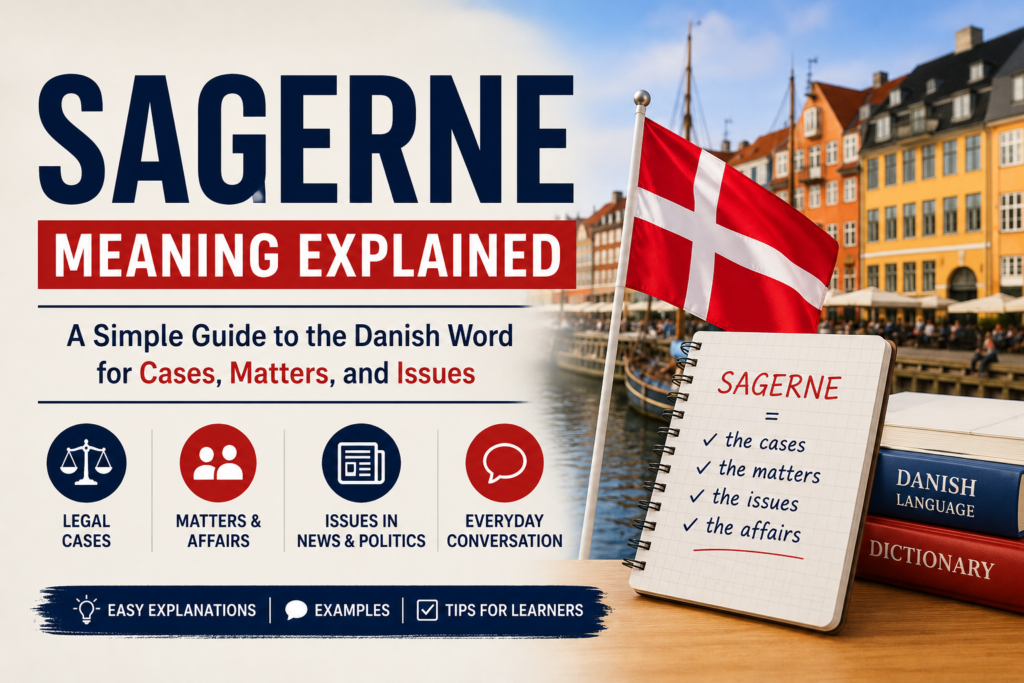
Language can sometimes feel confusing, especially when one short word has many possible meanings. Sagerne is a good example of this. At first, it may look like a difficult or unfamiliar word, but once you understand its basic meaning and usage, it becomes much easier. Sagerne is a Danish word. In English, it usually means the cases, the matters, the affairs, or the issues. The exact meaning depends on the sentence. It can be used in daily conversation, legal discussion, business communication, politics, news, education, and general problem-solving Rapelusr
What Does Sagerne Mean?
Sagerne is a Danish word that means “the cases,” “the matters,” “the issues,” or “the affairs” in English. It comes from the Danish word “sag,” which means a case or a matter. The exact meaning of sagerne depends on the context in which it is used. For example, in a legal situation, sagerne usually means the cases, while in a business meeting or normal conversation, it may mean the matters or the issues being discussed. In simple words, sagerne refers to specific topics, problems, cases, or matters that people already know about or are currently talking about.
Why Sagerne Has More Than One Meaning
Some words do not translate perfectly from one language to another. Sagerne is one of those words. Danish speakers may use it in many situations where English speakers would choose different words.
In English, we often separate words like case, issue, matter, affair, and lawsuit. In Danish, sag can cover many of these meanings.
This is why context is very important.
If sagerne appears in a court article, it probably means the cases.
>If it appears in a meeting, it may mean the matters.
>If it appears in political news, it may mean the issues.
>If it appears in personal discussion, it may mean the affairs or the matters.
The word itself is simple, but the meaning changes with the situation.
Sagerne in Danish Grammar
Danish nouns change depending on number and definiteness. This may sound difficult, but it becomes easier when you break it down.
The basic form is sag, which means a case or a matter.
The forms are:
en sag means a case or a matter
sagen means the case or the matter
sager means cases or matters
sagerne means the cases or the matters
The ending -erne is often used in Danish to show that a noun is plural and definite. That means the speaker is talking about specific things, not just any things.
So sagerne does not simply mean cases. It means the cases.
This small difference is important.
Sagerne as “The Cases”
One of the most common translations of sagerne is the cases. This is especially common in legal, police, official, or administrative contexts.
For example:
Politiet undersøger sagerne.
The police are investigating the cases.
Advokaten arbejder med sagerne.
The lawyer is working on the cases.
Retten behandler sagerne i næste uge.
The court will handle the cases next week.
In this meaning, sagerne usually refers to legal files, complaints, investigations, or official matters that are being reviewed.
This use is common in law, government, public administration, and news reporting.
Sagerne as “The Matters”
Another common meaning of sagerne is the matters. This is useful in business, education, meetings, and everyday conversation.
For example:
Vi må løse sagerne hurtigt.
We must solve the matters quickly.
Lad os gennemgå sagerne først.
Let us review the matters first.
Sagerne kræver mere tid.
The matters require more time.
In this meaning, sagerne does not always refer to legal cases. It can simply mean topics, concerns, or things that need attention.
This is a very practical use of the word.
Sagerne as “The Issues”
In news, politics, workplace discussions, and social topics, sagerne can also mean the issues.
For example:
Sagerne blev diskuteret i parlamentet.
The issues were discussed in parliament.
Journalisten skrev om sagerne.
The journalist wrote about the issues.
Sagerne skabte debat.
The issues created debate.
In this meaning, sagerne often refers to important topics that people are talking about. These may be political issues, social problems, public concerns, or controversial matters.
This use is common in media and public discussion.
Sagerne as “The Affairs”
Sometimes sagerne can mean the affairs. This meaning is more general and depends strongly on context.
For example:
Han blandede sig i sagerne.
He got involved in the affairs.
Sagerne udviklede sig hurtigt.
The affairs developed quickly.
De private sagerne blev ikke nævnt.
The private affairs were not mentioned.
This meaning can refer to events, personal matters, business affairs, or complicated situations.
However, in modern English, affairs can sometimes sound formal or old-fashioned. In many cases, matters or issues may sound more natural.
Sagerne in Legal Context
Legal language is one of the most important areas where sagerne appears. In Danish legal writing, sagerne may refer to court cases, lawsuits, disputes, criminal cases, civil cases, or official investigations.
A lawyer may talk about sagerne when discussing client files. A judge may review sagerne before a hearing. A police department may investigate sagerne if there are several related complaints or incidents.
In English, the best translation in this context is usually the cases.
For example:
Sagerne er endnu ikke afsluttet.
The cases have not been closed yet.
Der er nye oplysninger i sagerne.
There is new information in the cases.
Sagerne bliver behandlet separat.
The cases will be handled separately.
This shows how the word can be used in serious and formal situations.
Sagerne in Business and Work
In business, sagerne can refer to tasks, matters, client issues, internal problems, projects, or topics that need discussion.
A manager might say that the team needs to handle sagerne before the end of the week. This could mean pending tasks, customer complaints, legal documents, financial concerns, or project updates.
For example:
Teamet arbejder på sagerne.
The team is working on the matters.
Sagerne skal prioriteres.
The matters must be prioritized.
Vi tager sagerne op på mødet.
We will bring up the matters in the meeting.
In business English, the best translation may be matters, cases, tasks, or issues, depending on the situation.
Sagerne in News and Media
News articles often use words like sagerne because journalists write about public matters, investigations, political issues, legal cases, and social debates.
In media, sagerne may refer to several stories or cases being followed by the public.
For example:
Medierne følger sagerne tæt.
The media are closely following the cases.
Sagerne har fået stor opmærksomhed.
The cases have received major attention.
Politikerne kommenterede sagerne.
The politicians commented on the issues.
This use is important because it shows how sagerne can refer to public discussion, not only legal files.
Sagerne in Everyday Conversation
Danish speakers may also use sagerne in normal conversation. In casual use, it can mean the things being discussed, the problems being handled, or the matters that people are dealing with.
For example:
Hvordan går det med sagerne?
How are the matters going?
Jeg har styr på sagerne.
I have control of the matters.
Lad os ordne sagerne nu.
Let us sort out the matters now.
In English, these translations may change to sound more natural. For example, Jeg har styr på sagerne could also mean I have things under control.
This is why direct translation is not always the best choice. Natural meaning matters more than word-for-word translation.
Common Phrases With Sageirne
There are several useful expressions connected to sag and saigerne. These phrases can help learners understand how the word appears in real Danish.
At gennemgå sagierne
This means to review the cases or to go through the matters.
It can be used in offices, courts, meetings, and study situations.
At undersøge sagerne
This means to investigate the cases or to examine the matters.
It is common in police, journalism, research, and administration.
At løse sagerne
This means to solve the cases or to resolve the matters.
It can refer to problems, disputes, customer issues, or legal matters.
At tage sagerne op
This means to bring up the matters.
It is useful in meetings, discussions, and public debates.
At have styr på sagerne
This means to have things under control.
This phrase is more natural and practical in everyday conversation.
Sagerne and Search Intent
People who search for sagerne usually want to understand one of several things. Some may want the English meaning. Some may be learning Danish grammar, may have seen the word in a sentence and want to understand the context. Others may be translating a document, news article, legal text, or business message.
The main search intent is usually informational. That means readers want a clear explanation, not a complicated academic answer.
A good explanation of sagerne should answer these questions:
What does sagerne mean?
How is it used in Danish?
What is the root word?
What are the correct English translations?
When should I translate it as cases, matters, issues, or affairs?
How can I use it in a sentence?
This article covers all of these points in a beginner-friendly way.
Difference Between Sager and Sagerne
Many learners confuse sager and sagierne. The difference is small but important.
Sager means cases or matters in general.
Sagierne means the cases or the matters, referring to specific ones.
For example:
Jeg arbejder med sager.
I work with cases.
This is general.
Jeg arbejder med saigerne.
I am working with the cases.
This refers to specific cases already known.
The word the is the key difference in English.
Difference Between Sag and Sagierne
Sag is singular. Sagierne is plural and definite.
Sag means a case or a matter.
Sagierne means the cases or the matters.
For example:
Det er en vigtig sag.
It is an important matter.
Sagierne er vigtige.
The matters are important.
This difference helps learners understand how Danish nouns change.
Best English Translation for Sagierne
There is no single perfect translation for sagierne in every sentence. The best translation depends on context.
law, courts, police, investigations, files, or official complaints.
business, meetings, personal topics, or general concerns.
politics, social topics, public debate, or problems.
events, situations, or broader matters, but only when it sounds natural in English.
direct translation sounds too formal.
For example, Jeg har styr på sagierne is better translated as I have things under control, not I have control of the cases.
Practical Examples of Sagierne
Here are simple examples that show how sageirne works in different situations.
Legal Example
Advokaten forklarede sagierne for klienten.
The lawyer explained the cases to the client.
Business Example
Vi diskuterer sageirne på mandag.
We will discuss the matters on Monday.
News Example
Saigerne har skabt stor debat.
The issues have created major debate.
Personal Example
Hun vil ikke tale om sagierne.
She does not want to talk about the matters.
Workplace Example
Chefen bad medarbejderne om at afslutte sagierne.
The boss asked the employees to finish the matters.
These examples show why context is important.
Key Tips for Understanding Saigerne
Look at the Situation
Before translating sagierne, check the topic. Is the sentence about law, work, news, politics, or personal life? The topic will guide the meaning.
Avoid Word-for-Word Translation
Sometimes the direct translation sounds unnatural. Choose the English phrase that carries the same meaning.
Remember the Definite Meaning
Sagierne means the cases or the matters, not just cases or matters.
Learn the Root Word
Understanding sag makes saigerne much easier.
Read Full Sentences
Never translate sagierne alone if you have a full sentence. The surrounding words will help you choose the correct meaning.
Related Danish Words
Learning related words can make saigerne easier to remember.
Sag
This means a case, a matter, or an issue.
Sagen
This means the case or the matter.
Sager
This means cases or matters.
Sagsbehandling
This means case processing or case handling.
Sagsøger
This means plaintiff or person bringing a legal case.
Sagsmappe
This means case folder or case file.
These related words are often used in law, government, offices, and administration.
Common Mistakes With Sagierne
Translating It Only as Cases
Although the cases is a common translation, it is not always correct. In many sentences, the matters or the issues sounds better.
Forgetting “The”
Because sagierne is definite plural, it includes the meaning of the. Translating it simply as cases may miss part of the meaning.
Ignoring Context
The same word can change meaning in different settings. Always check the full sentence.
Using It Like an English Word
Sageirne is Danish, not English. It should only be used in English content when explaining Danish language, translation, or meaning.
Making the Meaning Too Complicated
The word is flexible, but the basic idea is simple. It refers to specific cases, matters, affairs, or issues.
FAQs
What does sagierne mean in English?
Sagierne usually means the cases, the matters, the affairs, or the issues. The best translation depends on the sentence and situation.
Is sagierne a Danish word?
Yes, saigerne is a Danish word. It comes from the noun sag, which can mean case, matter, issue, affair, or lawsuit.
What is the difference between sager and sagierne?
Sager means cases or matters in general. Sagierne means the cases or the matters, referring to specific ones.
Can sagierne mean legal cases?
Yes. In legal, police, court, or official contexts, sagierne often means the cases.
Can sagierne mean issues?
Yes. In politics, news, social discussion, or public debate, sagierne can mean the issues.
How do you use sagierne in a sentence?
A simple sentence is: Sagierne er vigtige, which means The cases are important or The matters are important.
Is sageirne formal or informal?
It can be both. It is used in formal settings like law and government, but it can also appear in everyday conversation.
What is the singular form of sageirne?
The singular basic form is sag, meaning a case or a matter.
Conclusion
Sagierne is a useful Danish word with several possible English meanings. It usually means the cases, the matters, the issues, or the affairs. The word comes from sag, a flexible Danish noun used in legal, business, political, personal, and everyday contexts. The most important thing to remember is that sagierne refers to specific plural things. It is not just cases or matters in general. It means the cases or the matters that are already known or being discussed. For beginners, the best way to understand sageirne is to look at the full sentence.